Leaderboard

All 4 schematics don’t work. Over grounding?

That sounds like it's proving my point: Zero resistance reads like a short in the cable or pickup, otherwise it should read the pickups DC resistance, which should be somewhere between 7 or 8k.
Yeah, bridge read at 8.25k. I’m guessing around 7k for the neck.

So you’re saying that being hooked up to the switch and testing the resistance, within the correct selector switch position, I should be able to get a MM reading on that neck pickup. Otherwise that too will read out at zero.

I’ll check to see if maybe the shield braid is making contact to a lug near the hot wire insertion as well.
 
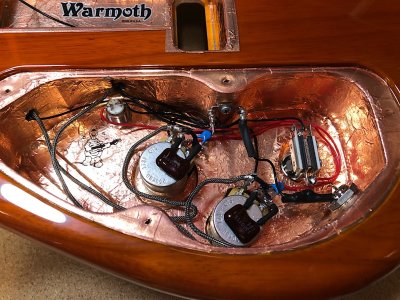
Check or ohm meter each pot leg to the copper shielding. The tangs for the pots are very close to its mounting surface. A slight bend would contact the copper foil, or there could be a small piece of foil from the hole cutout hanging around. I put a small piece of electrical tape between the pot tangs and the copper shielding in my builds.

View attachment 68367

In this pic, it appears to my eyes that the braided shield may contact the #1 or #2 terminal unintentionally when the hood is closed.
 
Yeah, bridge read at 8.25k. I’m guessing around 7k for the neck.

So you’re saying that being hooked up to the switch and testing the resistance, within the correct selector switch position, I should be able to get a MM reading on that neck pickup. Otherwise that too will read out at zero.

I’ll check to see if maybe the shield braid is making contact to a lug near the hot wire insertion as well.
Actually, no: I just suggested the bridge position of the switch, because in that position the neck pickup's hot side shouldn't be connected to anything, BUT that lug, as if it was "hangin' in the air" if you will.

That way, if you're reading anything else, but the pickup's DC resistance, the fault MUST be in the pickup, it's lead, or it's connection to the switch and/or volume pot.

English is not my first language, so maybe I wasn't making myself clear enough! 😅

I think your soldering looks otherwise very nice and clean, but I shared Hodgos observation:

There’s clearly something grounding out the signal when the neck is engaged based on the symptoms - the shielding is fine to share as many grounding points as you desire. My guess is some solder is accidentally bridging your signal and ground either on the back of the pot or at the switch connection in this part:

I don't know the exact material Lollar is using for their pickups, but I'm not the biggest fan of braided pickup wires for that same reason: I once melted hot solder through the insulation, shorting the pickup... 🫠

Btw.:
I’m using Alpha 500k pots since I’m using Q Parts Dome control knobs, due to their 6 mm fitting. No removable copper sleeves in these knobs to fit the 6.33mm CTS pots.
Why not use CTS split shaft pots? They also work with knobs with grub screws as long as that screw is facing the slot.

 
If anyone wants the equation to reading pickups already wired up, its:

The equation is (1/R actual) = (1/R measured) - (1/ R pot)

I also have a spreadsheet that will do this for you.
 
I don't know the exact material Lollar is using for their pickups, but I'm not the biggest fan of braided pickup wires for that same reason: I once melted hot solder through the insulation, shorting the pickup... 🫠
That’s my fear - that he burned through the insulation and shorted the inner signal wire.
Really braided wire is a problem waiting to happen.
It can be, but it also can dramatically cut down on shielding requirements. Still not the best solution in 2026, just tradition.

The trick is to always always pre-tin the braid and the pot. @Stewart1983 I would also see about a better soldering iron eventually. A 40W jobber can do it, but it probably sheds heat more quickly than needed.

Counterintuitive, but the best way to avoid a burned pot is a more powerful iron utilized very quickly, preferably with a chisel tip. It will stay hotter under load and let you flow pretinned joints together very quickly without causing the pot to overheat or melting through the insulation.
 
Back
Top