

Leaderboard

Tone / Volume controls?

Last Triumph

Senior Member
Messages
261
Any reason why I can't do away with them?

I only play in the house so it;s not like I'll be on stage or anything.

I've been playing for 20 years and can honestly say I never adjust the volume or tone controls, ever.

I have the tone on full clean and the volume on max and adjust those features on the amp.

If I want to shut the guitar up for a moment, I just hit the foot switch to put it on the clean channel and that stops any harsh noises.

Is there any reason why I couldn't just wire from the switch straight to the output jack?

I quite like the idea of a super clean look without all those knobs I don't use.

 
No reason you can't do that, if that's what you want.

The only question is whether you want to wire it (with a couple of resistors and a cap) to sound like V and T are there and turned all the way up, or just wire directly.
 
I'd be inclined to at least wire a mute switch. If you're after a super clean look you can put it in the side or back.
 
drewfx said:
No reason you can't do that, if that's what you want.

The only question is whether you want to wire it (with a couple of resistors and a cap) to sound like V and T are there and turned all the way up, or just wire directly.

Excuse my ignorance, but if I normally have the V & T on full, wouldn't it not sound the same with or without them?
 
swarfrat said:
I'd be inclined to at least wire a mute switch. If you're after a super clean look you can put it in the side or back.

Good idea.... maybe a little recessed slide switch in the rear route cover plate?
 
Last Triumph said:
drewfx said:
No reason you can't do that, if that's what you want.

The only question is whether you want to wire it (with a couple of resistors and a cap) to sound like V and T are there and turned all the way up, or just wire directly.

Excuse my ignorance, but if I normally have the V & T on full, wouldn't it not sound the same with or without them?

No, the pots decrease the output impedance.

Some people like the tone with no resistive loading, but most find it to make their guitar sound too harsh and trebley.
What you can do is wire a fixed resistor parallel to the output to simulate a volume pot, and a resistor in series with a capacitor to simulate a tone pot.

Use a 220k resistor to simulate a single 250k volume pot, or a 100k resistor to simulate two 250k pots in parallel. (*Technically, a 100k resistor in series with a 22k resistor, but the difference might not be noticeable.)

Use a 470k resistor to simulate a single 500k pot, or perhaps a 220k resistor to simulate two 500k pots in parallel.

The reason the resistances do not match the pot values is that 250k and 500k are uncommon values for resistors, so you have to take the closest substitute, unless you really want to get exact with series and parallel combos of resistors, which doesn't make much audible difference.

For the tone pots, use your same capacitor of the value of your choice, but replace the pot with a 220k resistor to simulate a 250k tone pot. In my limited experience fooling around with Jazz bass pickups, a 500k pot's resistance is great enough to effectively remove the capacitor from the circuit at the highest setting, but your results may well vary, so you can simulate a 500k tone pot on full with a 470k resistor.
 
line6man said:
Last Triumph said:
drewfx said:
No reason you can't do that, if that's what you want.

The only question is whether you want to wire it (with a couple of resistors and a cap) to sound like V and T are there and turned all the way up, or just wire directly.

Excuse my ignorance, but if I normally have the V & T on full, wouldn't it not sound the same with or without them?

No, the pots decrease the output impedance.

Some people like the tone with no resistive loading, but most find it to make their guitar sound too harsh and trebley.
What you can do is wire a fixed resistor parallel to the output to simulate a volume pot, and a resistor in series with a capacitor to simulate a tone pot.

Use a 220k resistor to simulate a single 250k volume pot, or a 100k resistor to simulate two 250k pots in parallel. (*Technically, a 100k resistor in series with a 22k resistor, but the difference might not be noticeable.)

Use a 470k resistor to simulate a single 500k pot, or perhaps a 220k resistor to simulate two 500k pots in parallel.

The reason the resistances do not match the pot values is that 250k and 500k are uncommon values for resistors, so you have to take the closest substitute, unless you really want to get exact with series and parallel combos of resistors, which doesn't make much audible difference.

For the tone pots, use your same capacitor of the value of your choice, but replace the pot with a 220k resistor to simulate a 250k tone pot. In my limited experience fooling around with Jazz bass pickups, a 500k pot's resistance is great enough to effectively remove the capacitor from the circuit at the highest setting, but your results may well vary, so you can simulate a 500k tone pot on full with a 470k resistor.

Every day's a school day!

If this is the case, do pick-up manufacturers design their pick-ups to run with a loading, rather than run 'free' to get the optimum sound?
 
Last Triumph said:
line6man said:
Last Triumph said:
drewfx said:
No reason you can't do that, if that's what you want.

The only question is whether you want to wire it (with a couple of resistors and a cap) to sound like V and T are there and turned all the way up, or just wire directly.

Excuse my ignorance, but if I normally have the V & T on full, wouldn't it not sound the same with or without them?

No, the pots decrease the output impedance.

Some people like the tone with no resistive loading, but most find it to make their guitar sound too harsh and trebley.
What you can do is wire a fixed resistor parallel to the output to simulate a volume pot, and a resistor in series with a capacitor to simulate a tone pot.

Use a 220k resistor to simulate a single 250k volume pot, or a 100k resistor to simulate two 250k pots in parallel. (*Technically, a 100k resistor in series with a 22k resistor, but the difference might not be noticeable.)

Use a 470k resistor to simulate a single 500k pot, or perhaps a 220k resistor to simulate two 500k pots in parallel.

The reason the resistances do not match the pot values is that 250k and 500k are uncommon values for resistors, so you have to take the closest substitute, unless you really want to get exact with series and parallel combos of resistors, which doesn't make much audible difference.

For the tone pots, use your same capacitor of the value of your choice, but replace the pot with a 220k resistor to simulate a 250k tone pot. In my limited experience fooling around with Jazz bass pickups, a 500k pot's resistance is great enough to effectively remove the capacitor from the circuit at the highest setting, but your results may well vary, so you can simulate a 500k tone pot on full with a 470k resistor.

Every day's a school day!

If this is the case, do pick-up manufacturers design their pick-ups to run with a loading, rather than run 'free' to get the optimum sound?

Very rarely do people play their pickups straight to the jack unless they are modding an instrument to remove the controls.
On some basses, however, the pickups are played into preamps with all controls placed after the preamp, or somewhere after the first input stage.

There is no "optimum sound." Pot values are largely personal preference, though some pickup makers have a suggestion of pot values for their pickups.

 
I'm using a DiMarzio Norton in the bridge and a Air Norton at the neck.

The DiMarzio website has plenty of wiring diagrams, but no specific values on the pots. They sell from their parts depot 250, 500 and 1M pots....

Any clues?  :binkybaby:

I was thinking of having just one knob on the front, a 3 position rotation knob for the pickup selection with maybe a push/pull for the mute?  (pull for mute)

Where would I start to replicate ideal values for those pickups?


Last Triumph said:
I'm using a DiMarzio Norton in the bridge and a Air Norton at the neck.

The DiMarzio website has plenty of wiring diagrams, but no specific values on the pots. They sell from their parts depot 250, 500 and 1M pots....

Any clues?  :binkybaby:

I was thinking of having just one knob on the front, a 3 position rotation knob for the pickup selection with maybe a push/pull for the mute?  (pull for mute)

Where would I start to replicate ideal values for those pickups?

If you have a volume pot in the circuit, don't worry about the resistors.

DiMarzio players tend to like 500k pots for high output.
 
There wouldn't be a volume pot in there....

Just a single switch with 3 way rotation pick-up switch to replace a 3 way toggle - the same switch having a push/pull to act as the mute we talked about earlier.
 
Last Triumph said:
There wouldn't be a volume pot in there....

Just a single switch with 3 way rotation pick-up switch to replace a 3 way toggle - the same switch having a push/pull to act as the mute we talked about earlier.

You're going to have a hell of a time finding a 3 position rotary toggle switch with a push/pull switch.
 
If you aren't nit-picky about tone, and would rather not have to make a run to Radioshack, then don't worry about putting resistors in to replace your circuit.  Your guitar's gonna sound a liiiiittle bit louder and a liiiittle bit brighter.  Just wire the selector switch straight to the jack, and adjust any undesirable differences in tone using the amp controls like you already do.
 
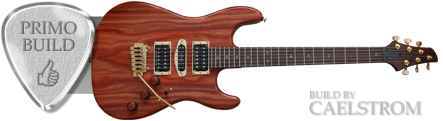
It'll be Korina/Maple top with either a Goncalo or Rosewood neck + Ebony board, so any additional brightness won't be an issue I don't think??

??
 
If you play high gain, you may prefer it with no resistors or cap. If you play warm, clean or bluesier stuff, you may prefer it with them.

If you aren't sure, just wire it straight and you can always add resistors/cap later.
 
I'd say it's time to break some old habits.  20+ years and not using the pots?  They do more than just make the guitar quieter.  The volume knob can clean up a distortion and change where the breakup is.  It's misleading to only think of the tone knob as a "tone" knob.  The volume knob also changes the tone.
 
One of the first amps I built, it had a single control, a volume knob labeled, "Tone", as in turn it up for more tone.  :icon_biggrin:
 
Needs a Turbo Deluxe Floyd said:
I'd say it's time to break some old habits.  20+ years and not using the pots?  They do more than just make the guitar quieter.  The volume knob can clean up a distortion and change where the breakup is.  It's misleading to only think of the tone knob as a "tone" knob.  The volume knob also changes the tone.

I appreciate what you are saying, but I either play clean as crystal, or high gain and nothing in between - just the sorts of music I like to play. I always use the amp to change tone or break up levels.
 
Back
Top