Leaderboard

New video: What if Malcolm Young played a Wramoth?

Hollow body, chambered, thinline, et al; the delineations between all those things can get a little loosey-goosey. The Mooncaster is listed as a hollow carved top, but it's not a true hollow body in the sense that a Gretsch is. But it is also definitely more than simply "chambered" or "thinline".

The entire body core is cut from a single piece of wood, and the wings are completely hollowed out. Then the top is glued on.

When Ken Warmoth was developing the Mooncaster, he actually purchased a custom shop Gibson 339, because they are made the same way. It's still sitting in the Warmoth headquarters, nearly untouched for 15 years. I've been scheming about how to "permanently borrow" it for that entire time. Creative suggestions are welcomed.

If one were to hypothetically clone the Gibson as a Mooncaster, what would the specs be?
 
If one were to hypothetically clone the Gibson as a Mooncaster, what would the specs be?
Ostensibly that would be an all maple (core and top) Mooncaster with all the controls except the lower horn toggle, humbuckers, TOM bridge, ivoroid binding. Mahogany Hombre neck with rosewood or ebony fretboard and trapezoid/split/block inlays and again ivoroid bindings

Gibson 57 Classic neck, 57 Classic Plus Bridge and 2v2t 500k wiring with .022uf caps.
 
How some of the little things in these videos may have unexpected impacts: I'm using that exact same bridge in a different build and the tips and discoveries like this are very, very helpful.
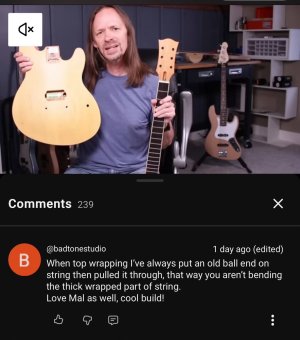
I read this in the comments for that video and thought “Well, that sounds pretty clever. I will log that one away for if I ever use one of them bridges…”
1776047807292.jpeg
 
By the way, I am still unclear about the Mooncaster: does it have a center block or no? And if it doesn't have a center block, then why also is not correct to call it fully hollow?

Actually the term semi-hollow might be better for Warmoth to use as a term for this construction type. @aarontunes

"Semi-hollow" might be a more accurate term. "Thinline" is pretty close too. But at this point there is so much builder-logic/builder-images/info page links, etc tied to all the various names of things that changing the terminology is not as easy as just changing some text.
 
By the way, I am still unclear about the Mooncaster: does it have a center block or no? And if it doesn't have a center block, then why also is not correct to call it fully hollow?

@stratamania got it exactly right, but to reiterate: It doesn't technically have a "center block", but it essentially does.

The center portion of the body, extending from the heel through the pickups and bridge areas and ending at the lower strap button, is all one solid piece of wood. But it is not a "center block" in the traditional sense of the term, because the entire body is not a "hollow body" in the traditional sense of the term.

Rather, the entire body core is routed from a single piece of wood, and then the maple top is glue on.

It is basically exactly the same as thinline construction, but not Tele-shaped: the wings are hollowed completely out, but the center is left intact.
 
I read this in the comments for that video and thought “Well, that sounds pretty clever. I will log that one away for if I ever use one of them bridges…”
View attachment 68424

Yes, 100%

I saw that comment too, and was going to respond with "great tip!", but got lost in some other tasks and never had a chance to come back to it.
 
When the Thinline was released Fender actually referred to it as semi-solid in their advertisements. It was also routed out from the back, not the front, and had a cap of wood placed over the back. This is also how Paul F Bigsby did it on the Merle Travis guitars.

In the same era Gibson’s Electric Spanish (ES) line referred to their guitars as hollow or semi-hollow depending on the presence of a center block, but the bodies were the same otherwise: bent laminate top/back/sides joined with kerf lining, not unlike an acoustic guitar.

Nowadays, Fender refers to the Thinline as semi-hollow instead of semi-solid, while Warmoth refers to their Thinline and other similar construction guitars (VIP, Mooncaster) as hollow, to distinguish from their chambered bodies. Nothing they make meets the original Gibson definition of semi-hollow or hollow.

In fact a Gibson with the same amount of wood removed as a Warmoth hollow body is simply called “chambered” while the bodies they build similar to Warmoths chambered bodies are called “weight relieved”. When Gibson builds a body similar to the Mooncaster (CS-336 or CS-356) they still called it “chambered” or sometimes “totally carved”, but not semi-hollow.
 
When the Thinline was released Fender actually referred to it as semi-solid in their advertisements. It was also routed out from the back, not the front, and had a cap of wood placed over the back. This is also how Paul F Bigsby did it on the Merle Travis guitars.

Thanks for that little nugget. I had no idea.

In the same era Gibson’s Electric Spanish (ES) line referred to their guitars as hollow or semi-hollow depending on the presence of a center block, but the bodies were the same otherwise: bent laminate top/back/sides joined with kerf lining, not unlike an acoustic guitar.

Nowadays, Fender refers to the Thinline as semi-hollow instead of semi-solid, while Warmoth refers to their Thinline and other similar construction guitars (VIP, Mooncaster) as hollow, to distinguish from their chambered bodies. Nothing they make meets the original Gibson definition of semi-hollow or hollow.

In fact a Gibson with the same amount of wood removed as a Warmoth hollow body is simply called “chambered” while the bodies they build similar to Warmoths chambered bodies are called “weight relieved”. When Gibson builds a body similar to the Mooncaster (CS-336 or CS-356) they still called it “chambered” or sometimes “totally carved”, but not semi-hollow.

Yep, totally. As I said above, all these terms can get a little loosey-goosey.
 
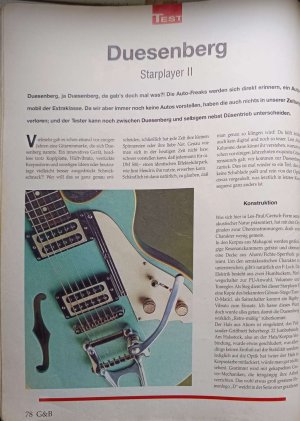
The Duesenberg Starplayer II from 1996 was build like Warmoths Mooncaster, but with a flat top, before introducing the semi-hollow Starplayer TV.
1000472066.jpg

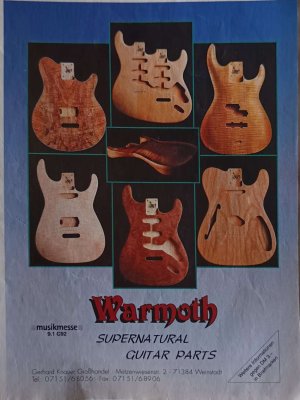
I posted this picture from a german guitar magazine (Gitarre & Bass) not long ago, because I also found this add in there...

1000472065.jpg

Duesenberg kind of re-released that earlier version, calling it Starplayer CBR, mahagony body (which they call "chambered") with a flat maple top.
 
Owning a Doozy Starplayer TV (for a decade+), I can attest it is a true semi hollow. A back, top and sides glued together with a separate center block glued in. Is ala a 335, but it is smaller and the back is much more arched than a 335 or a Gretsch.

Oh and if ever you go down that rabbit hole, make sure it is P90 neck and HB bridge. The middle position defined CCM for a while.
 
Back
Top